Australia’s Housing Pipeline Is Recovering; But the Economy Is Starting to Work Against It
Approvals, commencements, finance and employment | 2019–2026

Whilst the market continues to soften, almost everyone agrees that Australia needs materially more housing, yet the latest data reveals a delivery system in which planning approvals, construction activity, finance and labour-market conditions are not moving in unison. The central policy question is no longer simply how many dwellings are approved, but how efficiently approved supply is converted into financed projects, construction starts and completed homes.
The July 2026 Building Approvals release is encouraging in trend terms. National trend approvals reached 18,365 dwellings, 11.7% above a year earlier. Seasonally adjusted approvals were 17,687, down 3.6% in July but 9.0% higher annually. Private-sector dwellings excluding houses were particularly strong, up 19.9% over the year. This is evidence that the forward pipeline is rebuilding and that higher-density product is again contributing more meaningfully to supply.
However, approvals are only one component of the housing system playbook. March quarter commencements fell 11.2% to 48,012 dwellings on a seasonally adjusted basis, even though the underlying trend reached 51,009 and was 11.7% higher annually. June-quarter housing finance also weakened: the number of new dwelling loan commitments fell 5.4%, owner-occupier commitments fell 3.3% and investor commitments fell 8.6%. At the same time, the July unemployment rate reached 4.5% nationally. The combined picture is therefore one of improving prospective supply but increasing economic resistance to converting that pipeline into much needed and deliverable housing.
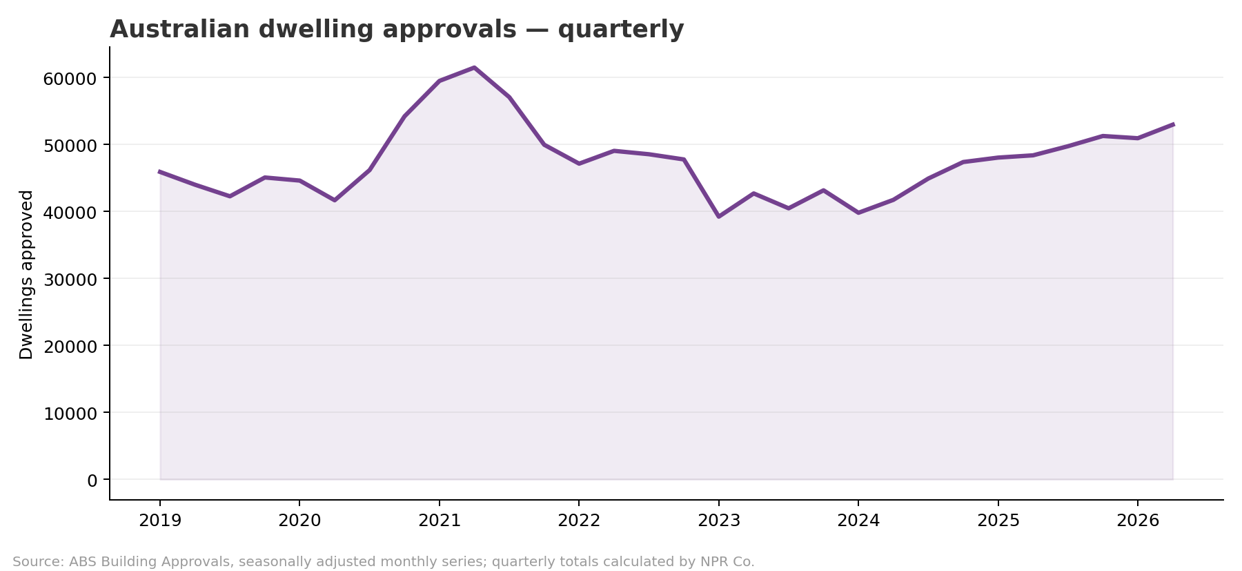
The quarterly approvals cycle shows the extraordinary HomeBuilder era surge, the subsequent rate and cost driven contraction, and a meaningful recovery through 2025–26. The recovery is real, but it has not yet returned the housing system to a position where supply is clearly outrunning underlying requirements.
Approvals are recovering — but approvals are not supply
The distinction between an approval and a completed dwelling is both obvious and fundamental to the property industry. An approval demonstrates planning and regulatory capacity. It does not guarantee that a project is financeable, presold, serviced, constructed or completed. Between approval and occupation sit infrastructure delivery, construction costs, labour availability, development finance, purchaser borrowing capacity and market confidence to name a few of the hurdles.
The composition of approvals is also becoming more important. Detached housing remains central to Australia’s outer-suburban and masterplanned-community markets, but the strong annual growth in non-house approvals indicates that apartments, townhouses and other forms of attached housing will need to carry a larger share of future metropolitan supply if they are a viable built form outcome. To some extent, this may also be influenced by the location of our emerging employment nodes which are now more varied than the equation of white collar equals the CBD. More jobs are being created in our suburbs than the CBD at present, a trend that looks as difficult to change as hybrid employment conditions.
Commencements reveal the conversion problem
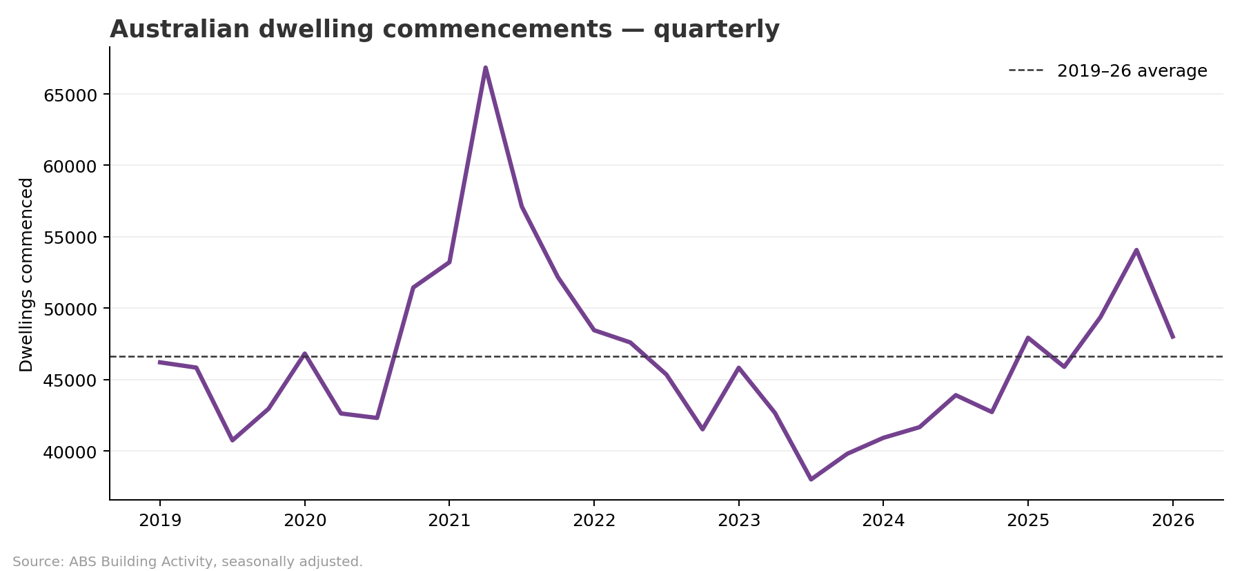
National commencements provide a clearer picture of physical delivery. The 2020–21 stimulus cycle pushed starts to exceptional levels, peaking at 66,848 dwellings in the June quarter of 2021 which was driven by the start of a massive influx of international migrants. The subsequent contraction was prolonged, with commencements falling below 40,000 by late 2023. The recovery since then is encouraging, but the March 2026 seasonally adjusted fall to 48,012 illustrates the volatility and fragility of the construction response and does not reflect the changes to housing introduced into the May Budget. It is anticipated that this negative trajectory will continue to experience the firm pull of gravity.
Five major capital-city markets: one national problem, different cycles
Sydney, Melbourne, Brisbane, Adelaide and Perth should not be treated as a single market. Their supply cycles, labour markets, housing mix, affordability constraints and investor exposure differ materially. For construction commencements, the ABS series is most robust at a State level, so NSW, VIC, QLD, SA and WA are used below as clearly identified proxies for the five capital-city development markets outlined below.
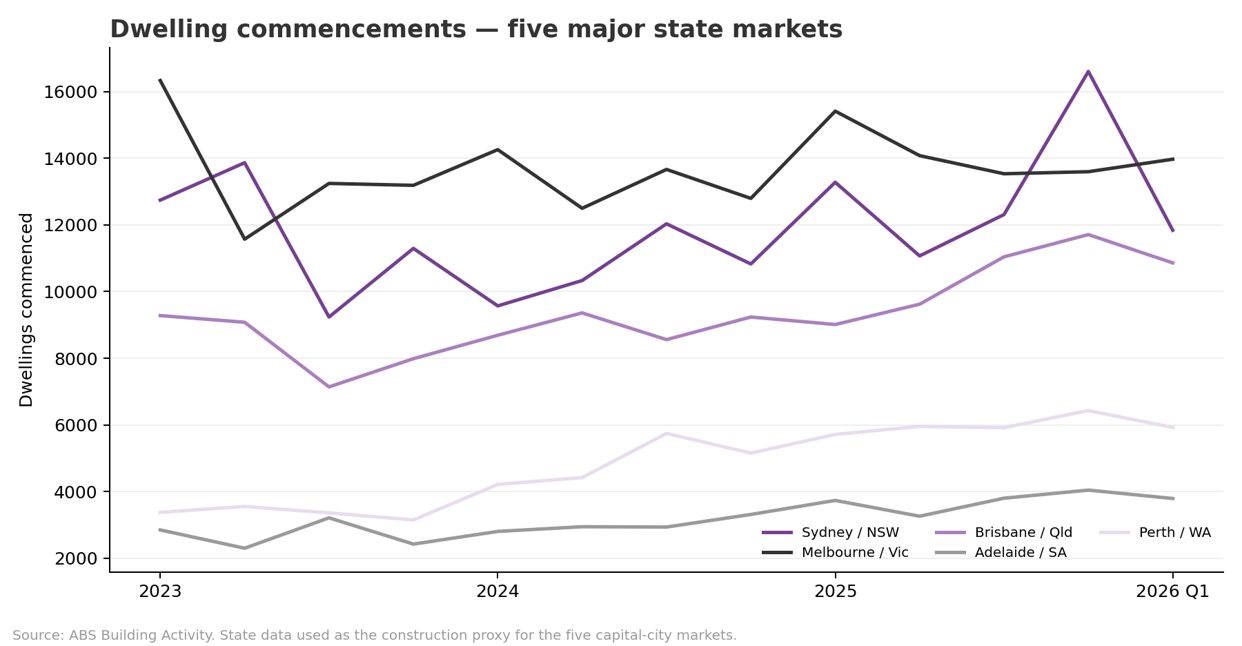
The divergence is striking. Victoria continues to generate the largest absolute volume of commencements among the five states, but its trajectory has been comparatively subdued. Queensland has strengthened through 2025 and remains a major source of new housing delivery. Western Australia has experienced the most pronounced relative uplift from its 2023 base, consistent with Perth’s strong population, price and development cycle. South Australia has also lifted from a smaller base. NSW remains volatile and continues to face the structural challenge of converting very strong housing need into sufficiently high delivery volumes at prices the broader market can sustain.
Finance is becoming the constraint between demand and delivery
The June-quarter finance data is the clearest warning that the housing market cannot be judged from approvals alone. The number of new dwelling loan commitments fell 5.4% nationally and the value fell 5.2%. Owner-occupier loan numbers declined 3.3%, while investor loan numbers fell 8.6% and investor lending values fell 10.2%.
This matters directly to new supply. Developers require purchasers with sufficient borrowing capacity; apartment projects often require substantial presales; investors remain important to many higher-density projects; and developers themselves face higher debt and holding costs. A planning approval that cannot attract finance is not effective housing supply, a concept that is often lost in the broader commentary.
The monetary-policy contradiction is therefore becoming increasingly important. Higher interest rates suppress household demand and inflation, but they can also reduce the feasibility of future housing. Australia can restrain housing demand today while simultaneously delaying the supply needed tomorrow. If household formation and population growth continue to exceed completions, that constraint eventually re-emerges through rents, affordability pressure and higher housing costs which will influence the length and depth of any correction. The Master Builders Association notes, “Nationally, June 2026 was a particularly difficult month, with 339 construction businesses entering external administration. Of those, 140 were based in New South Wales, highlighting the ongoing pressures facing builders and subcontractors across the State.” There is not a lot of room to move in new housing builds, with the human side being businesses going broke. The May Budget may well see this trend continue as starts are falling away, display villages are seeing less patronage and new land releases that would have been swamped with enquiry are often very quiet. A housing contraction of any sustained length will have enormous consequences across the whole of society.
Employment is the demand-side foundation
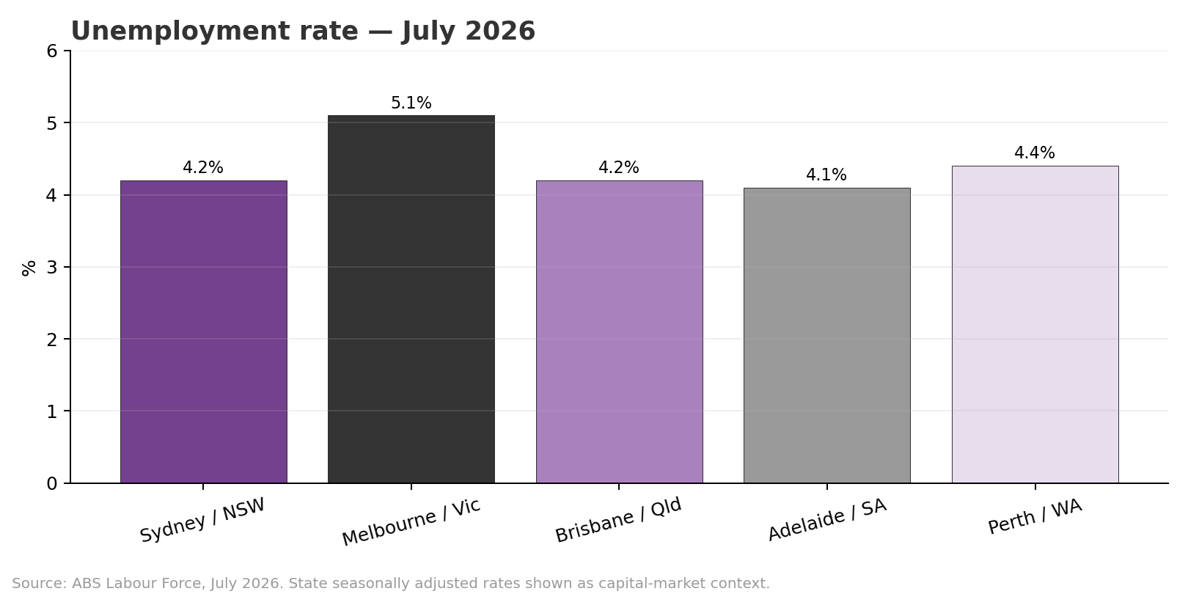
Housing demand ultimately rests on employment and income. In July 2026, Australia’s unemployment rate was 4.5%. Among the five corresponding States, Victoria recorded the highest rate at 5.1%, followed by Western Australia at 4.4%, NSW and Queensland at 4.2%, and South Australia at 4.1%. These remain relatively low unemployment rates historically, but the labour market is softer than it was at the peak of the post-pandemic cycle.
The distinction matters for housing. A gradual rise in unemployment can reduce household formation, borrowing capacity, buyer and consumer confidence and investor appetite. Conversely, it can also eventually reduce construction labour pressure and inflation. The latest data for household savings shows that the lower consumer confidence and higher cost of living has translated into a reduction from 7.0% of income to 6.2%. For developers and policymakers, the critical question is whether labour-market softening becomes sufficient to weaken housing demand before financing conditions improve enough to stimulate new supply all the while with demand increasing through interstate and international migration…depending on the State.
For Sydney, Melbourne, Brisbane, Adelaide and Perth, the implication is that the next phase of the housing cycle will be determined less by whether governments can announce additional dwelling capacity and more by whether the market can convert that capacity into economically viable projects. Each city will travel a different path, but the national challenge is the same: planning capacity must become construction capacity, and construction capacity must become completed homes.
Australia therefore needs to stop asking only, “How many dwellings did we approve?” The more consequential questions are: How many obtained finance? How many commenced? How many were completed? And how long did the conversion take? Until those measures improve together, the housing shortage will remain one of Australia’s most significant social and economic constraints.
Matthew Gross | Director | mgross@nprco.com.au
Nicholas Price | Associate Director | nprice@nprco.com.au