Without Investors, Rental Stress Remains Widespread

Interestingly about three weeks ago we released a newsletter looking at rents at an LGA level highlighting the problem with the current budget policy changing tenure, but not supply. The media has now cottoned onto this and realised that the attempt to make housing more affordable, has actually made it less affordable for those who can’t afford to buy property. With a national capital city vacancy rate sitting at 1.2%, the problem is only going to get worse before it gets better…and that will likely be quite a way off.
Looking specifically at Queensland’s suburban rental affordability problem highlights it is ultimately a supply problem. Whether in our major capital cities, fast-growing outer metropolitan corridors or regional communities, the underlying pressure is increasingly the same: the number of households competing for housing is growing faster than the stock of dwellings available to accommodate them. Unless that imbalance is addressed through materially higher and more sustained housing delivery, further rental escalation is not simply possible—it is the logical market outcome.
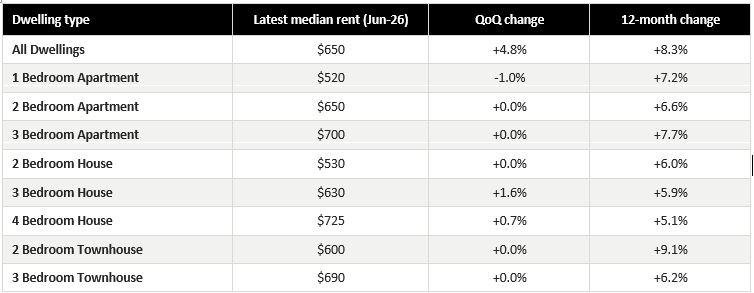
Queensland’s latest rental evidence demonstrates how entrenched that pressure has become. Median rent across all dwellings reached $650 per week in the June quarter 2026, 8.3% higher than a year earlier, while every major dwelling type recorded annual rental growth. Importantly, the pressure is not confined to one segment of the market: annual increases ranged from 5.1% for four-bedroom houses to 9.1% for two-bedroom townhouses. The longer-term charts in the report are particularly telling, showing a pronounced acceleration in rents from around 2021 across apartments, houses and townhouses alike. The report associates this period with exceptionally strong population growth and persistently tight rental vacancy.
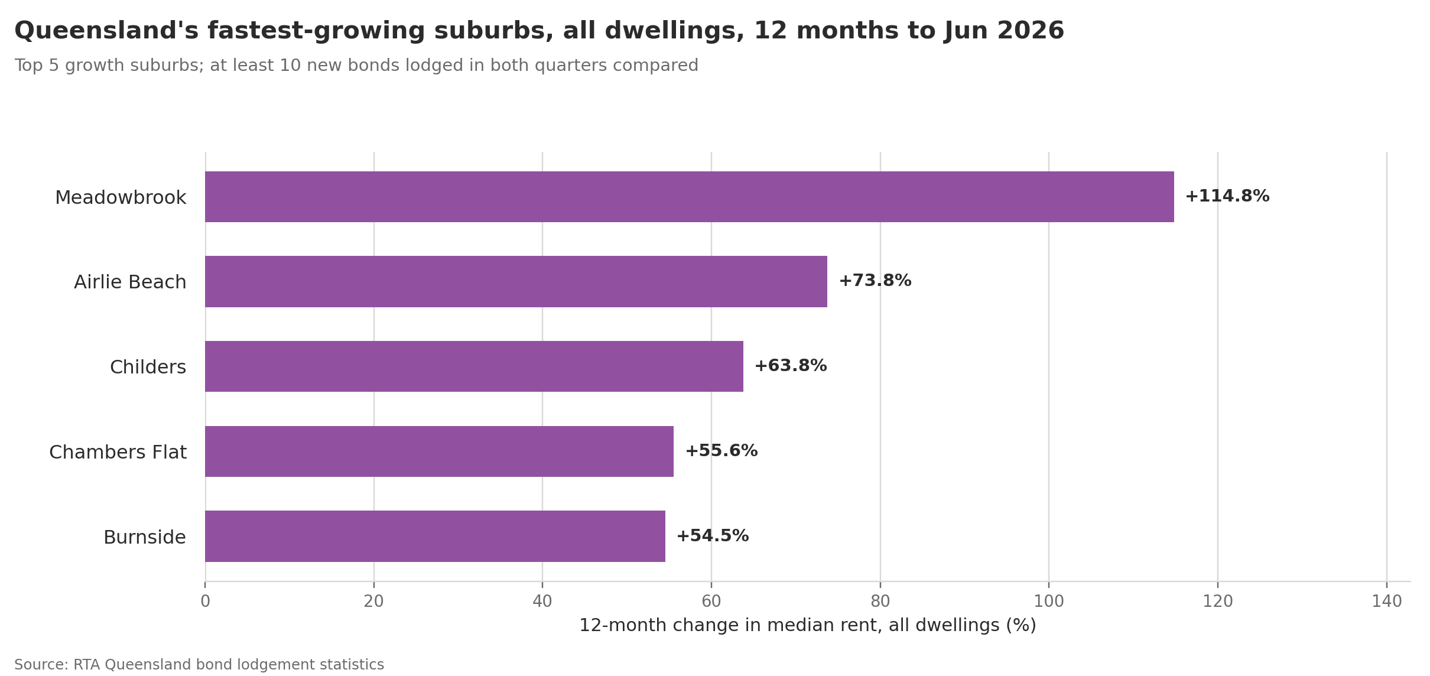
The significance is that rental stress is no longer exclusively a capital-city phenomenon. The suburb-level results show substantial increases across metropolitan Brisbane, the Gold and Sunshine Coasts and regional centres. This geographical spread matters. Regional markets cannot indefinitely absorb population displaced by metropolitan housing costs if those regions are themselves failing to add sufficient housing. Moving demand from a city to a regional centre does not solve a housing shortage—it merely relocates it.
Housing supply therefore needs to increase across the entire settlement system. Cities require greater infill, apartment, townhouse and greenfield delivery, while regional communities require a dependable pipeline of serviced land and new dwellings appropriate to their growing populations. Without that supply response, households will continue competing for an inadequate pool of properties, vacancies will remain constrained and landlords will continue to encounter tenants willing—or forced—to pay progressively higher rents.
The equation is remarkably simple: population growth creates households; households require homes; and where the number of homes does not keep pace with the number of households, the adjustment occurs through price. In the rental market, that price is rent. Policies designed to address affordability without materially increasing the number of dwellings may redistribute some of the pressure, but they cannot remove the underlying scarcity. If Australia wants to arrest the escalation in rents, it must build more homes—and it must build them in both our cities and our regions.
The following tables and graphs are mostly created at a suburb level outlining the top five suburbs by product type.
State of the Queensland rental market
Rent growth has been broad-based across every dwelling type over the past year, though the pace has eased from the sharper increases seen in 2022–23. The chart below tracks the state median for each property category back to 2012 — the acceleration from 2021 onward is visible across every panel, coinciding with Queensland's strongest population growth in a generation and a rental vacancy rate that has remained persistently tight.
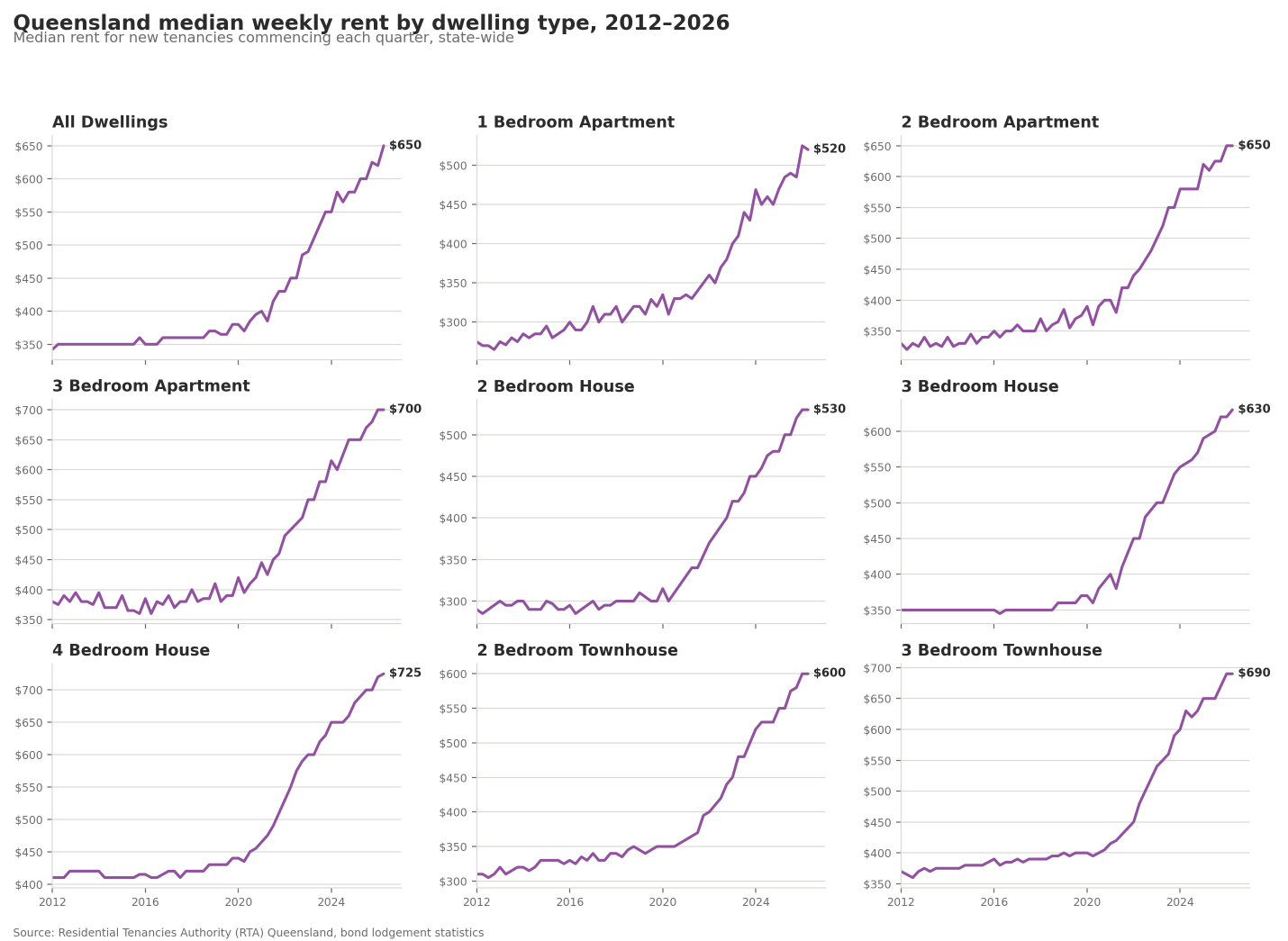
Queensland median rents by property type
Queensland's biggest suburb movers — all dwellings
Before breaking movers down by property type, here is the combined "all dwellings" picture — every new tenancy regardless of bedroom count or dwelling style. Because this figure blends whatever mix of properties happened to lease in a given suburb each quarter, a swing here can sometimes reflect a change in which properties leased (e.g. more houses and fewer flats) rather than like-for-like rent growth — the property-type tables in Section 3 isolate that effect. Treat the all-dwellings figures as a useful headline, and the property-type tables as the more reliable read on genuine rent movement.
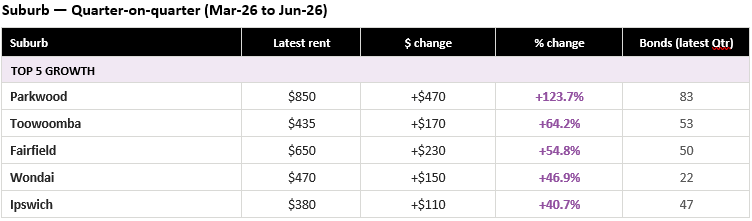
Suburb movers by property type
The tables below isolate each of the eight tracked property types, so a rent movement reflects genuine change for a like-for-like dwelling rather than a shift in what happened to lease that quarter.
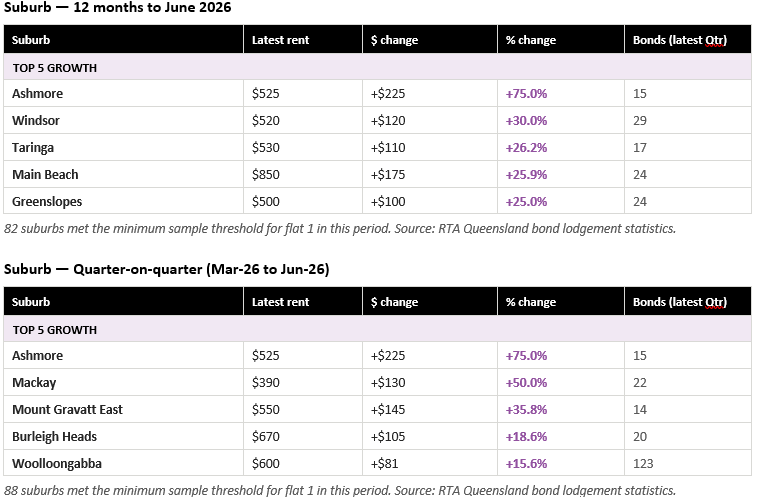
1 Bedroom Apartment
One-bedroom flats and units (RTA category: Flat 1). Queensland median: $520/week in the June 2026 quarter
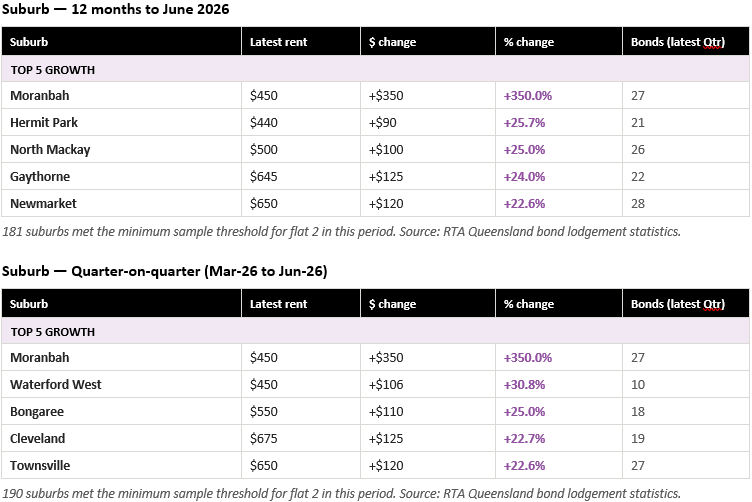
2 Bedroom Apartment
Two-bedroom flats and units (RTA category: Flat 2). Queensland median: $650/week in the June 2026 quarter
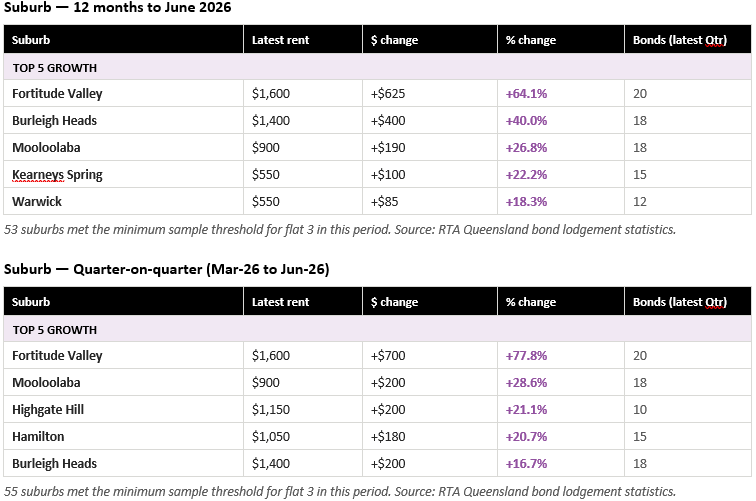
3 Bedroom Apartment
Three-bedroom flats and units (RTA category: Flat 3). Queensland median: $700/week in the June 2026 quarter
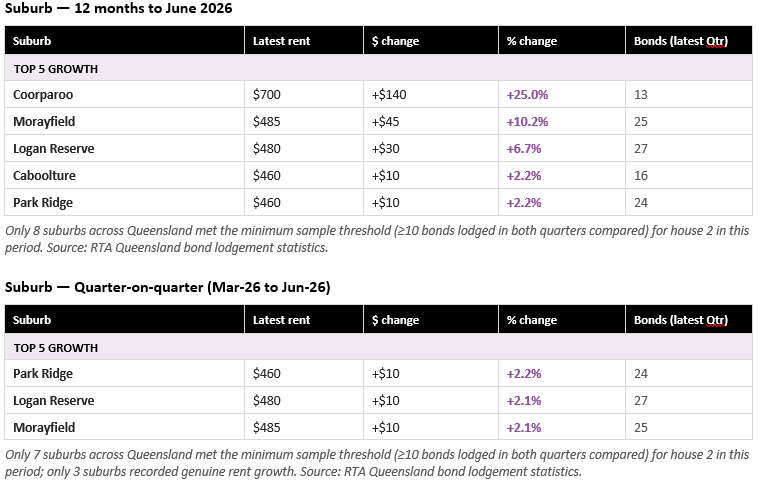
2 Bedroom House
Two-bedroom houses (RTA category: House 2). Queensland median: $530/week in the June 2026 quarter
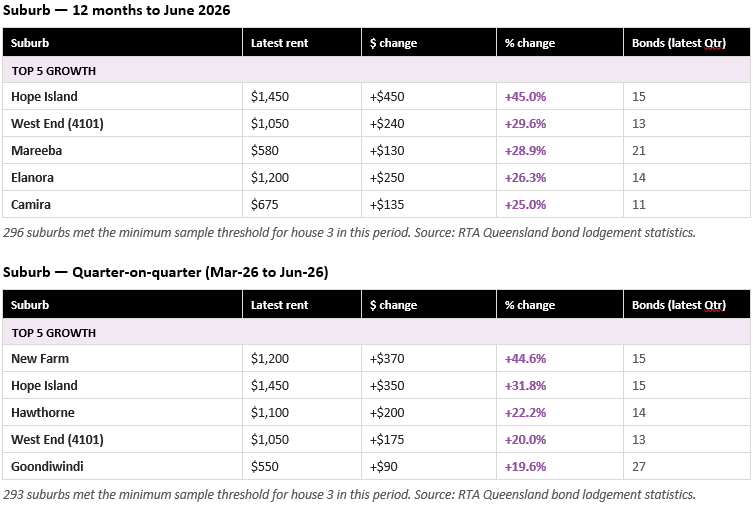
3 Bedroom House
Three-bedroom houses (RTA category: House 3). Queensland median: $630/week in the June 2026 quarter
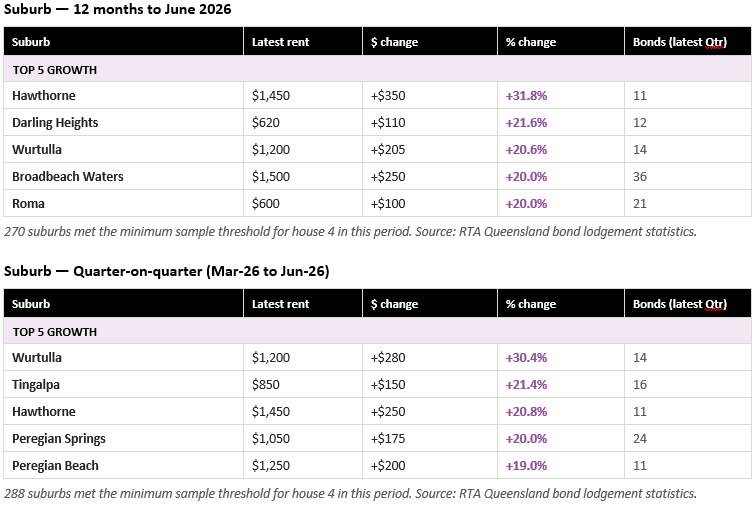
4 Bedroom House
Four-bedroom (or more) houses (RTA category: House 4). Queensland median: $725/week in the June 2026 quarter
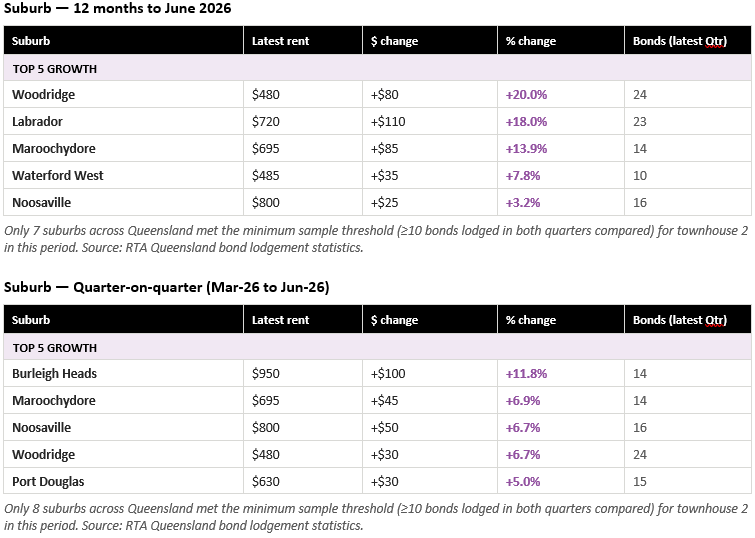
2 Bedroom Townhouse
Two-bedroom townhouses (RTA category: Townhouse 2). Queensland median: $600/week in the June 2026 quarter
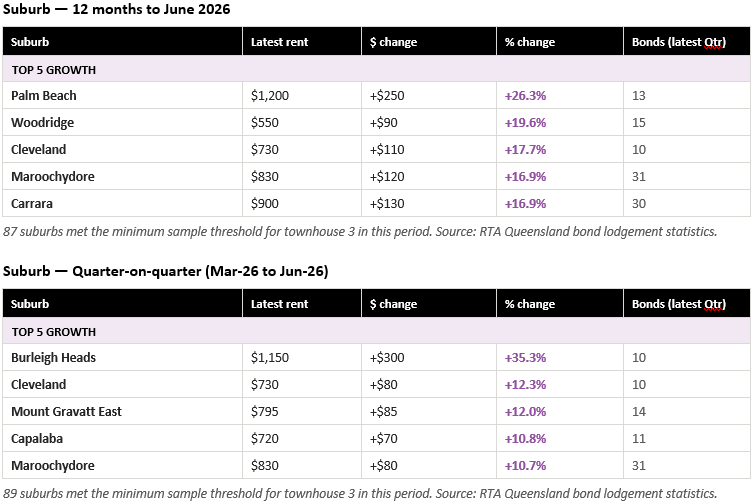
3 Bedroom Townhouse
Three-bedroom townhouses (RTA category: Townhouse 3). Queensland median: $690/week in the June 2026 quarter
Matthew Gross | Director | mgross@nprco.com.au
Nick Price | Associate Director | nprice@nprco.com.au