How many people are enough?

The latest population data has been released and whilst the eastern seaboard has started to return to more traditional levels of growth, it is far from being slow. There have however been some interesting changes that will flow through many parts of society; whether that is the requirement for additional housing, more healthcare, jobs or even retail.
Over the last quarter, Australia grew by 111,090 which means we needed to add almost 44,500 dwellings. If we look at the last twelve months, Australia would needed to have built 169,500 dwellings to account for the population growth of 423,595 people. It wasn’t so long ago that population growth forecasts of 250,000 people per annum would raise the debate around a “Big Australia”.
Natural Increase
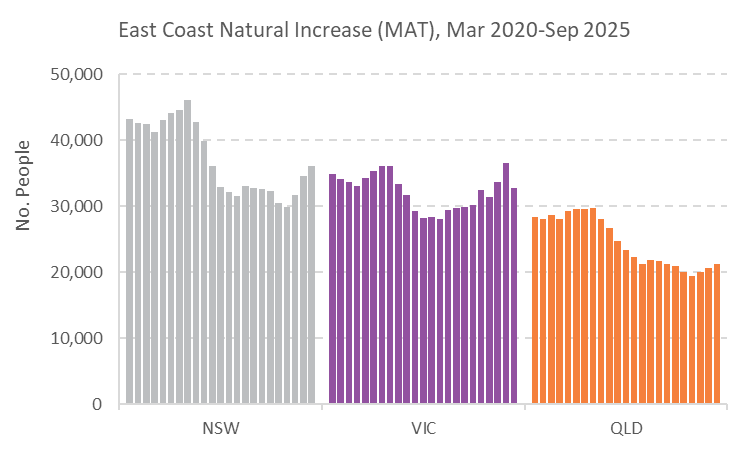
The post pandemic period was particularly tough on young families. The rate of natural increase which by definition is more births than deaths over a defined period of time demonstrated that there were some doubts about young people thinking about starting or increasing their family size. The replacement level fertility rate to keep the population balanced in 2.1 children per woman. In 1999, this was already low at 1.66 children per woman, however in 2024 it declined to its lowest point at just 1.48 children per woman. Without international migration, Australia’s population would be going backwards. Knowing that our young family households are actually getting smaller, not bigger; it does beg the question about what does a first home actually look like? Are we building to the current needs of those households, or the expected needs of those future households…which by the way on the current data is probably not going to look much different.
Interstate Migration
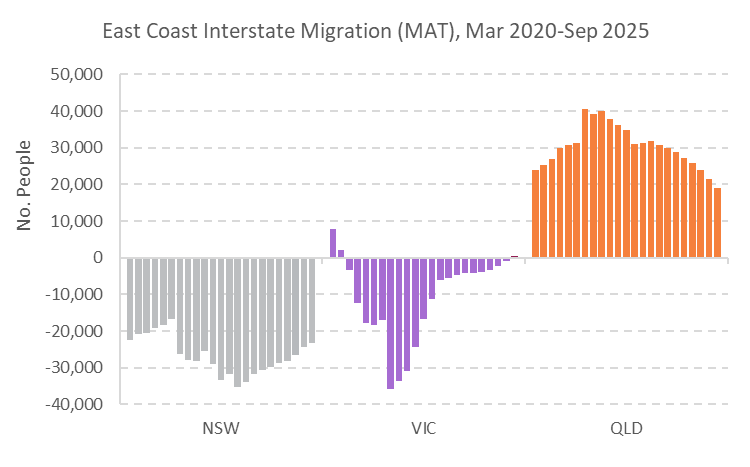
In our last newsletter we stated that some of the fundamentals for the greater Melbourne market has started to turn around. Demand for housing had improved, there was starting to be some price growth after years of challenging market conditions. We also speculated that although the data wasn’t available at the time, it was highly likely that the interstate migration would turn positive; and it has. The population movements across the east coast of Australia have slowed. It is not something that can be attributed to employment conditions or opportunities, every State in Australia is at full employment. Lifestyle moves are only relevant when there is a financial incentive to move, that is leaving a more expensive destination to a cheaper destination whilst enhancing one’s living arrangements. As prices in many of these destinations, particularly Queensland have become more expensive, the push and pull factors diminish. To this point, it is not usually the retirees making these shifts, but the 25-45 year olds who are often less embedded in their communities.
A point to consider is that continued interest rate increases will likely slow migration further at this point in the cycle for SEQ, favour Victoria and hurt NSW, the most expensive residential market in Australia.
International Migration
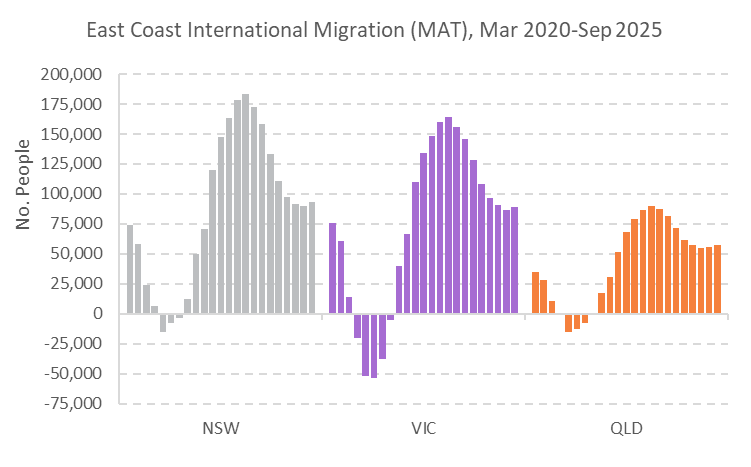
This is the elephant in the room that put enormous pressure on Australia’s housing stock in such a compressed period of time. This is not to suggest that immigration is a bad thing, simply that the levers that govern the volumes have needed to be readjusted, and to some extent they have. Acknowledging the fact that without immigration, Australia’s population would be going backwards, at least in the short to medium term. Whilst the simple equation that property would ultimately be cheaper, there simply would not be enough people to drive a society based on services and consumption. Without immigration, Australia would likely enter a prolonged period of recession. The nation would not have the capacity to care for our elderly, retail would stagnate, our cities would start to empty, funding infrastructure would be challenging and our healthcare system would become overloaded.
There are successful economies internationally that have coped with a declining population, however they have achieved this through their workforce working to older ages, increasing the number of women in the workforce, improving productivity through investment in technology and robotics. The key is boosting productivity through individual workers, something Australia has, and continues to struggle with. So for now, International Migration is critically important to Australia’s economy.
Below are the East Coast summary graphs by State.
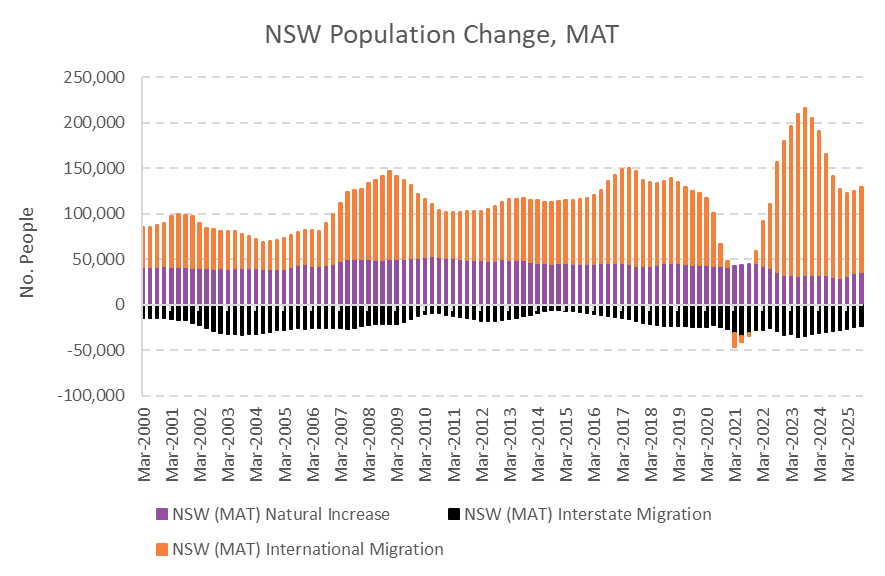
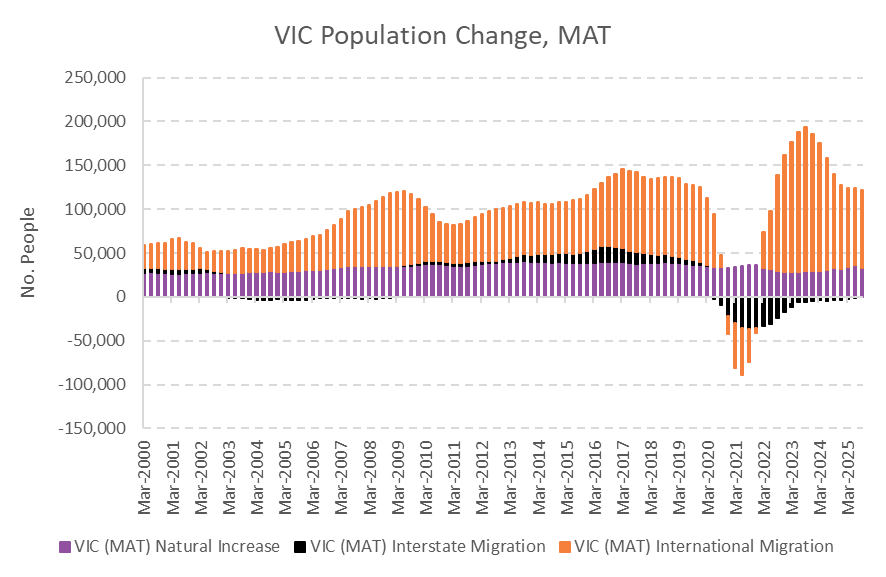
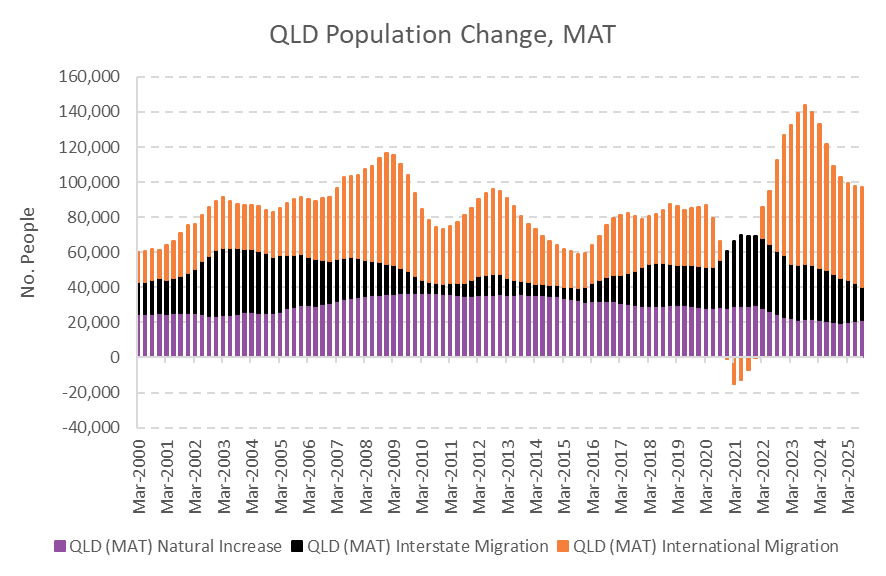
So where does this leave our Property Industry? Historically there would be a real risk of overshooting supply and turning the market back into one that favours the purchaser. At present, it seems like we are long way from this happening with low vacancy rates, the inability to deliver any meaningful numbers of medium and high density residential and a footprint which is constrained by mandated developable boundaries rather than the geographic obstacles typifying the past. The rate of builders entering liquidation is still high, skilled labour is in short supply and world events continue to challenge supply chains or create economic hardship that could not have been foreseen in projects at their inception. Hence many builders and developer are being overexposed by circumstance, not poor management. If times were easier, the skylines of our near city suburbs would look like echidnas with the sheer volume of cranes required to meet demand.
The challenge with any aggressive population policy is making sure everything is in place beforehand to meet the demand. Somehow this lesson was forgotten and being relearnt the hard way right now.
Matthew Gross | Director | mgross@nprco.com.au
Nicholas Price | Associate Director | nprice@nprco.com.au