THE CAPITAL CITY TAX

For decades, Australians have been encouraged to believe that the capital cities offer the ultimate combination of employment, prosperity and lifestyle. The implicit message has been simple: to get ahead, move to the city. But what if that assumption has become one of our most expensive economic habits?
The “capital city tax” is not a government levy. It is the additional housing cost that households may accept to live in a metropolitan market, even where credible employment and lifestyle alternatives exist elsewhere. That premium can translate into larger mortgages, less discretionary income and reduced capacity to save and invest.
The question is not whether Brisbane and other capitals matter. They do. It is whether the premium paid to live in them always reflects a commensurate gain in opportunity.
The price of choosing the capital
The comparison of Queensland local government areas places Brisbane’s 2026 house price at $1.48 million. Toowoomba is $840,000, Bundaberg $725,000, Gladstone $649,000 and Rockhampton $640,000. These are substantial gaps, even before the cost of financing is considered.
House Prices 2019 and 2026
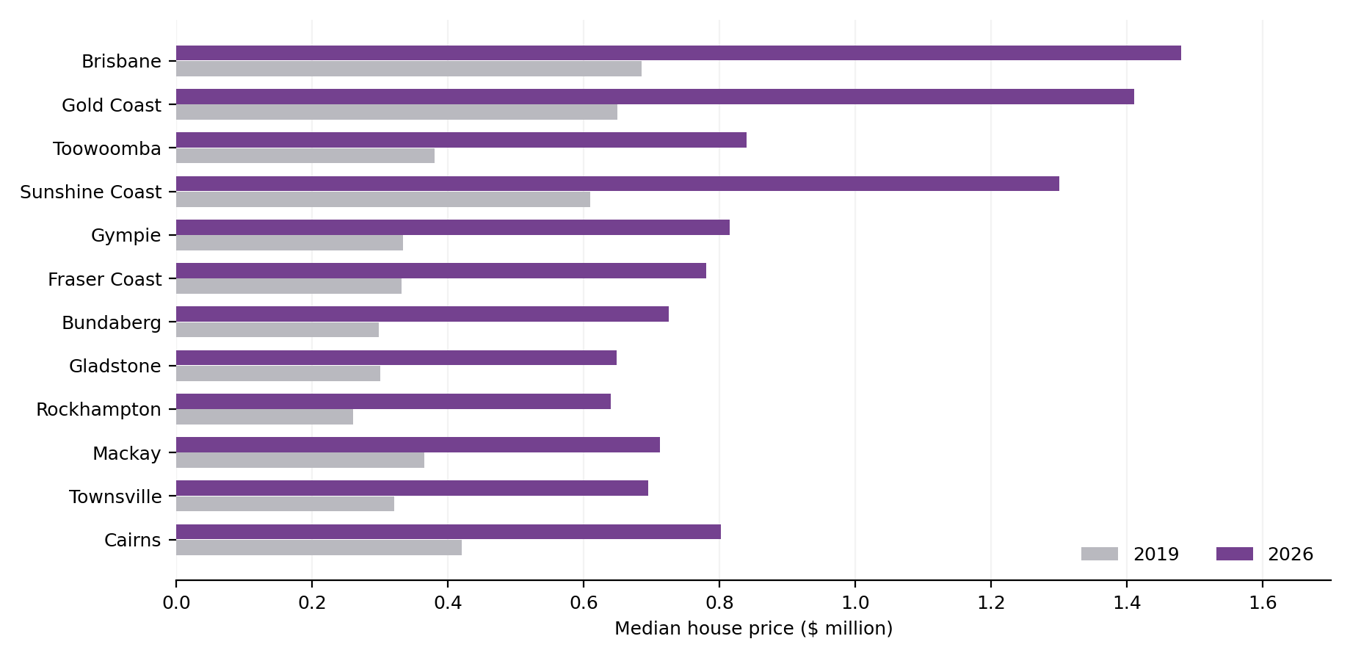
The comparison is based on local government boundaries not individual suburbs and is simply to generate discussion
What is the capital city premium?
When considering different markets, a buyer in Rockhampton would face an $840,000 lower purchase price than in Brisbane. The equivalent differences are $831,000 in Gladstone, $785,000 in Townsville and $640,000 in Toowoomba as examples. These are indicative purchase-price differentials, not guaranteed net financial savings; acknowledging that household incomes, financing, transaction costs, insurance and housing characteristics will obviously vary.
Purchase Price Savings to Brisbane
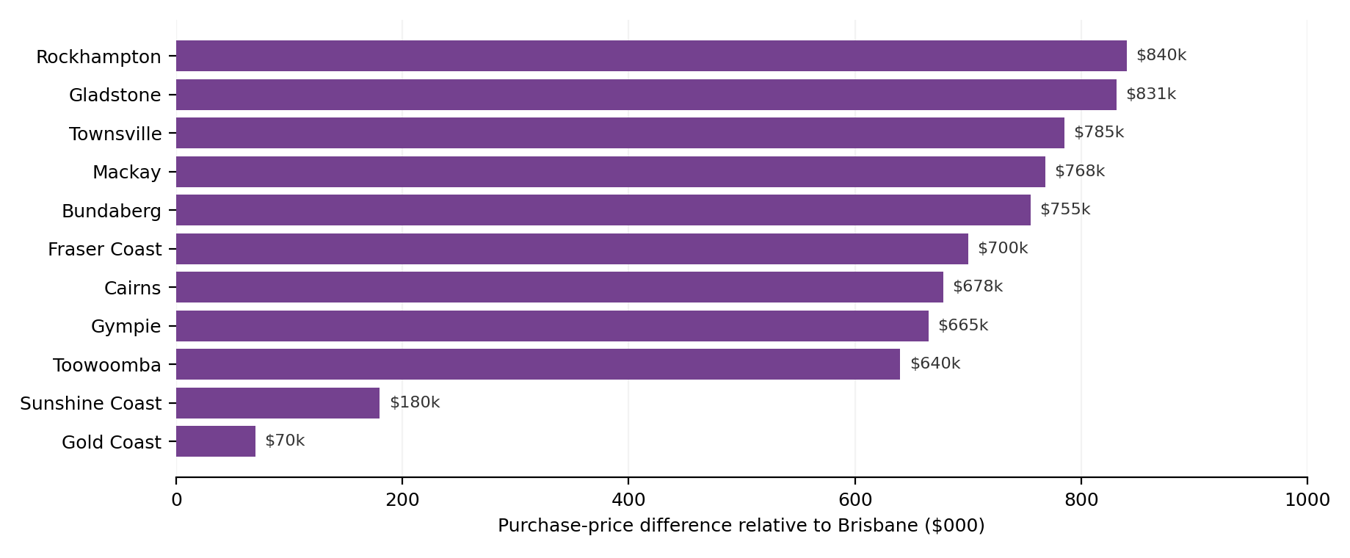
To illustrate the cash-flow effect, financing a $640,000 difference over 30 years at an assumed 6% principal-and-interest rate adds approximately $3,837 per month or circa $46,000 annually in after tax dollars to repayments.
Regional employment is not an afterthought
The proposition that regional living requires abandoning economic opportunity is increasingly difficult to sustain as a general rule. Toowoomba supports agriculture, logistics, healthcare and education. Gladstone has substantial port, industrial and energy-related activity. Mackay is tied to engineering, resources and agricultural services. Townsville combines defence, logistics, government, health and education, while Cairns has tourism, aviation and a substantial service economy.
These are established employment centres, not merely residential alternatives to Brisbane. Nevertheless, regional labour markets are not uniform: specialist occupations, career progression and job security differ between centres and households. However; as these regional centres continue to grow, so too does the diversity and opportunity.
The regions have not stood still
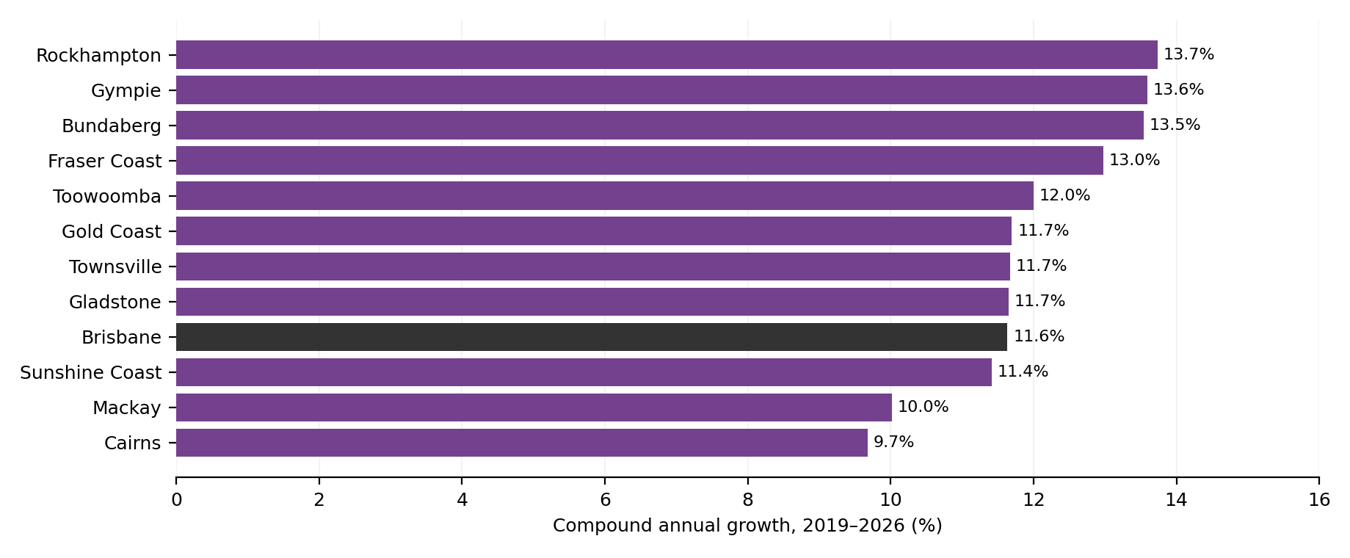
Regional housing has also experienced considerable appreciation. The 2019 and 2026 figures imply strong compound price growth in several centres, indicating that the affordability advantage is not static. Indeed, population and investment flowing into a constrained regional market can erode that advantage if housing delivery does not keep pace. Having a shortage of builders is not solely the challenge of SEQ.
Housing Compound Growth 2019-2026
Have we missed the opportunity to grow our regions?
Not yet. But Australia has arguably been too comfortable with the idea that population, infrastructure and investment should continue concentrating in a handful of metropolitan areas. Metropolitan agglomeration offers genuine productivity benefits, but concentration also carries costs: housing scarcity, congestion, long commutes and escalating infrastructure requirements. All of which typically impact lifestyle in a negative way.
The lifestyle dividend
For some households, regional living offers a larger home, shorter commute, stronger community connections and or more discretionary income. For others, access to specialist careers, tertiary education, healthcare and cultural networks makes metropolitan living preferable. Neither choice is inherently superior. The right comparison is the standard of living a household can achieve after housing, transport and other unavoidable costs are considered, not the perceived prestige of a postcode.
A national growth strategy hiding in plain sight
The capital city tax is ultimately a challenge to an entrenched assumption: that proximity to a capital is the necessary price of prosperity. Australia has capable regional cities with established industries and significant capacity to contribute more to national population and economic growth. The opportunity has not disappeared; it requires deliberate planning and investment.
If households can access good jobs, affordable housing and essential services in more places, regional development becomes more than a lifestyle proposition—it becomes a productivity, affordability and national resilience strategy.
Matthew Gross | Director | mgross@nprco.com.au
Nicholas Price | Associate Director | nprice@nprco.com.au