Prices Up, Volumes Down. The Time for Change is Now.

Published on Topic:

The Queensland residential market has remained one of the most patchy in the country.  With the start of the year showing signs of recovery, only to falter in mid-February and March leaving the industry to ponder when the dead cat bounce will actually stop. 

Now for all those people wedded to the simplistic theory of “Supply and Demand”, the below graph demonstrates that despite the challenging conditions, land prices continued to grow in the face of significantly declining volumes for the majority of centres.  There is no guessing where the impact of the Coal Seam Gas (CSG) terminates with Gladstone having historically the lowest land values now almost on par with the Gold Coast.  The resource boom is real and the workforces to drive these billion dollar projects are massive, in their thousands.  However they are geographically isolated and bring their own sets of problems and benefits to each community.  The supply of land and accommodation being one of them.

Screen Shot 2013-02-20 at 5.20.16 PM.png

Graph 1 : Median Land Prices for Queensland’s Major Centres, 1991-2011

Over the last three years, many of these centres have experienced declines in land sales by as much as 68% despite prices increasing and lot sizes falling.  If you are in the business of building homes, quite clearly your volumes are going to be well down on what many have forecast in their budgets.  You simply can’t have a strong home building sector if land sales are at record or near record lows. 

This is even more relevant in the South East corner of the State where the volumes are the most significant.  This has historically been the engine room of the State.  This has certainly changed in the short term, but balance will again be found within the next three years.  While Gladstone is the shining light at present, it still only represents 600-700 new house starts per annum in a very good year, a fraction of what SEQ should be achieving. Given that every house generates four direct jobs and three indirect jobs, this is a substantial part of the economy that has gone missing.  So whilst the previous government targeted the housing sector through the building boost, perhaps one might argue that they put the horse before the cart.  Without strong land sales, new house sales realistically can only be weak.

Screen Shot 2013-02-20 at 5.20.23 PM.png

Graph 2 : The Change to Land Sales Volumes SEQ, 2009-2011 (old LGA boundaries)

As we started the article discussing dead cat bounces, the mandate the new State government brings to the table should allow for some fresh consumer confidence.  Clearly the public wanted a change and that is hopefully what they will get.

If NPR could influence one aspect of the changes that the government could effect and effect quickly, it would be a decrease in stamp duties.  By raising the stamp duty in the past combined with the building boost (a mixed message if ever there was one), instead of increasing funds into the government coffers, it has only served to weaken the sector through declining volumes.  A three year moratorium on reduced stamp duties would help the sector recover whilst adding more income into the state through greater volumes in land sales and by default, the general housing sector. 

If the industry and government can get the grass roots fundamentals right, Queensland will be well on its way to discovering the prosperity it was so well known for.  Do this and interstate migration will again start to ratchet up.  The new cycle will begin.

This will be the test for Campbell Newman.  As Ross Noble in his English accent put it, “will it be Can Do Campbell Newman or Candy Newman…”  Virtually all of Queensland is hoping for the former, the results of the election speak volumes for how flat consumer confidence was in this State.  The rebuilding of Queensland now begins, pardon the pun.
Affordability and the Return to a More Balanced Market

Published on Topic:

I know this topic has been done to death and there have been numerous ratio’s used to support one argument or the other depending on who is paying the bills and level of independence involved.  However the real measure of affordability I am going to suggest might be something different.  It will also be something that can be measured when the most recent data from the census is released.

In looking at the affordability matrix, analysts have typically looked at household incomes or individual incomes to determine what the level of repayments that can be sustained or the multiplier of income to median house prices is.  From this, the market is either at, above or below historical levels.  What it fails to take into consideration is the time value proposition for money, duration of debt and equity achieved.  The average loan size tells more about what is going on than any ratio.

Screen Shot 2013-02-20 at 5.10.32 PM.png

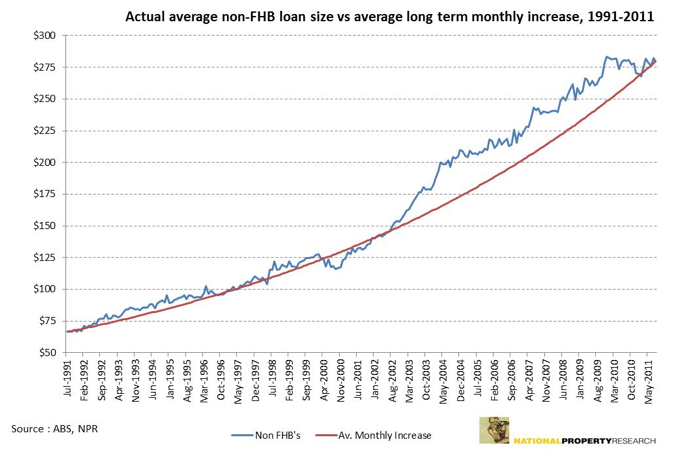
Interestingly the research actually shows that what people can afford to pay as a measure of average loan sizes suggests that a temporary ceiling has been reached.  The average loan size in Queensland has been hovering around $275,000 for the past 2-3 years which is essentially the centre point for the bell curve.  Fixed at five years this equates to a weekly repayment of around $660 per week.  However as interest rates appear set to fall, there should not be the expected inverse correlation of purchasers looking to borrow more.  The expected outcome is that some of this money will find its way back into retailers pockets.

Another important factor to note is that over the past twenty years, the average monthly growth in loan size is 0.59%.  If this was applied to the starting point in the time series, the current monthly loan size for Non-FHB’s would be $279,631.  The actual loan size at this point in time is $279,900.  Quite clearly the excesses of the 2003 to 2009 period can be seen in the graph below with the impact this has had on the average monthly increase line.  Having said that, the graph also gives consideration to the difficult economic times of the 1990’s, so there is some degree of balance.

Screen Shot 2013-02-20 at 5.10.42 PM.png

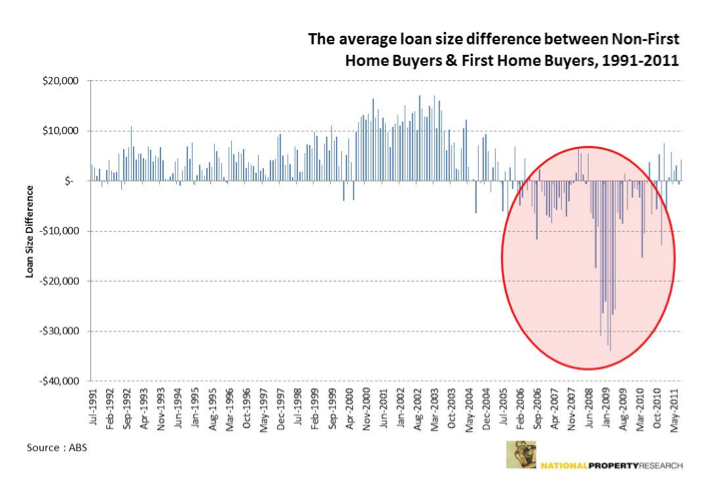
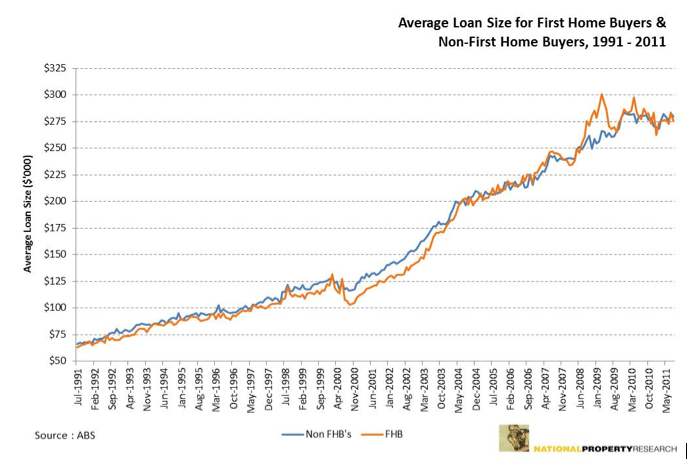
 The above graph doesn’t show the changing market sentiment, however recent history allows us this quick view in the rear view mirror.  The 2003 to 2009 period saw the market shift from the Non FHB to the FHB.  Hence this actually exacerbated the residential market run.  So whilst the author acknowledges the peak in 2007 in the residential market, structurally it changed to take on unprecedented characteristics not seen since reliable data collection occurred.  This change is outlined in the graph below.

The interesting aspect of the average home loan size is that for the majority of the last two decades, Non-first home buyers have typically had the larger average mortgage.  This has been turned upside down in the last five years with first home buyers taking on mortgages that have at times been over $30,000 more than the former.  Admittedly this occurred when they received stimulus funding both at a Federal and State level which in hindsight probably saw some purchasers biting off more than they could chew.  It is too early to tell whether this correction back to more normal cycles is underway, though the expectation of NPR is that by this time next year, Non-FHB’s will again be taking on slightly larger debt than the first home buyer market.

Screen Shot 2013-02-20 at 5.10.51 PM.png

This is a really important trend for the residential market.  The benefit of having a stronger Non-FHB market is that it represents a much larger part of the buying cohort and signals that a more normal cycle is likely to get underway.  The other really important part of the change back is that the equity that this buyer has allows them to purchase both new and established dwellings more easily.  This is the sector of the market that needs to gain in confidence and will also be the one that benefits the residential sector the most from a decline in interest rates.

The Need to End the Bust

Published on Topic:

When you work in property, the one thing you learn early on is that it is cyclical by nature.  There are good times and are there are challenging times.  Unfortunately those challenging times have been with us now for near on three years and people are getting fatigued.  Every time there appears to be some light at the end of the tunnel, government policy either local or abroad has everyone trimming their sails getting ready for the next storm…real or otherwise.  We have to stop taking rumour as fact and jumping at shadows.  It is very difficult to rebound when the collective conscience is on edge.

Screen Shot 2013-02-20 at 5.13.26 PM.png

The last significant downturn occurred in mid 1985 and lasted approximately three years.  In 2000 the introduction of the GST combined with the Tech Wreck dented confidence and created a degree of uncertainty about a new taxation system.  This was shortly lived as the market bounced back after being in a five year period of below average performance.  In many respects, there are some similarities between the GST period and where we currently find ourselves.  Comparisons can also be made to the period surrounding 1987 and the stock market crash which saw the bottom of this building approval downturn.  Having stated that, most people were not so heavily geared back then.  This has changed the fundamentals of the market dynamics in ways which were not foreseen, however with hindsight, greater degrees of transparency and discovery it was obvious the eye was “off the ball.”

When you consider that the level of approvals are down, and typically not all approvals reach construction, the above graph is somewhat sobering.  Representing less than 4.0% of market activity, the purchase of new dwellings whilst having not changed dramatically as a proportion, it has in volume.  Herein lies the rub. The building industry continues to lose some of its long term capacity to the resource sector, which is after all a labour mobility issue which has helped many households stay above the bread line.  The big problem that looms is a shortage of apprentices and young people that will be able to step up to the plate when the housing sector recovers…and it will recover and probably with a rush.  Every recovery from a significant downturn has been equally steep in its upturn, making sure we have the skills to cope with this will be imperative to keeping a lid on affordability.

Screen Shot 2013-02-20 at 5.13.36 PM.png

On that note, it is with some trepidation that a loophole in housing GST appears to be closing.  Whilst the intention was clearly that a loophole in the taxation system should not exist for new houses in the first place, the introduction of draft legislation by Bill Shorten could not have come at a worse time for the industry.  Not only that, if successful it will be retrospective back to January this year, meaning that many house builders may find their taxation bills significantly higher than was originally perceived.  As many builders are currently sailing close to the wind, the potential damage to this stressed sector of the economy will be felt on a wide scale.  Keeping in mind that for every house built, effectively seven jobs are created.

If the housing sector is to not only survive, but be placed in a position from which to grow from, change is needed on a broad scale.  This should be approached with a whole of industry focus in a unified front between the UDIA, Property Council, Master Builders Assoc, Housing Industry Assoc and someone from the relevant state and federal treasury.  Until everyone’s cards are laid on the table, the solution will continue to be pushed away like bobbing for apples in a bucket.

Market Volatility

Published on Topic:

The current volatility of the world economy will have some significant ramifications for property investors, owner occupiers and developers alike.  At this point in time, it is too early to tell just which way the market will go.  Historically there has been a link between the ASX performance and housing finance approvals.  When the ASX has dropped, finance approvals have followed the trend.  Essentially this means less supply into the market.  However the timing of the Queensland Government housing stimulus package may initially provide some form of a buffer.

With less supply into the market, one could make the assumption that rents will increase because in theory vacancy rates will tighten.  This is particularly true if you believe that Australia has an undersupply of residential property, the author does not share this opinion.  However (and there will be a few of those), there is an expectation that employment will soften as a result.  With Bluescope Steel making workers redundant and Qantas threatening to send jobs offshore, there is a very real economic restructuring taking place in Australia.  Already the most recent (July 2011) data shows that this is the case.  So people are going to be cautious about outlaying more of their income in rents.  Investors shouldn’t be seeing the potential tightening of the vacancy rates as an opportunity to lift rents. 

On the upside of this is that interest rates may actually start to fall.  Again it is too early to determine whether this is the case as the last quarterly CPI data came in at 0.9%.  This is outside the RBA’s guidelines of an annual band ranging from 2.0% to 3.0%.  So whilst inflation is up, many of the country’s major employment sectors are struggling; in particular retail, manufacturing, tourism and property to name a few.

With property prices having declined in most capital cities, the RBA would actually be quite happy that this is occurring in a very orderly and gentle manner.  The last thing the RBA wants is for house prices to drop dramatically like they have elsewhere in the world, which is unlikely given the strong fundamentals of our economy.  However they would like to see it become more affordable.  With annual wage growth continuing around 3.5%p.a and property prices softening, the affordability equilibrium will by default occur sometime within the next five years if current trends continue.  This is based on the assumption that no value shocks occur over this period of time.

One thing we can be grateful for, is that if the market and economy should start to trend into a major downturn, which is unlikely so long as China and India continue to experience such massive domestic expansion, the RBA does have quite a lot of stimulatory power with the cash rate at 4.75%.  With the start of the GFC in 2008, the RBA demonstrated it was prepared to move swiftly in order to help the economy through the tough times.  It will do so again if it feels the need to and if inflation is under control.

At present the property market is suffering largely from a lack of confidence.  This could not be more evident than in Queensland and W.A.  Both capital cities, and in particular their surrounding regions, are experiencing some of the toughest conditions on record.  If you believe in the longer term fundamentals of both of these capital cities then there are some very good buying opportunities to be had.  What the purchaser has to be sure of in their own judgement, is whether they are getting great value or market value.

One thing is for sure though, whether the market is up, down or sideways; most people have to buy and sell in the same.  The gap between the mid range properties and the top priced properties has shrunk considerably since 2007 in almost every market in Australia. 

The difference this time round is that the general public are arguably not as highly geared and unlikely to face the extraordinary number of margin calls seen through 2008.  What we may see is the market go back to working counter cyclically.  Residential property may be seen as a safe and defensive strategy in these uncertain times when shares have become and remain highly volatile.  This may prove particularly true for those approaching retirement who look to spread their risk across a number of different investment classes.

Confidence surrounding our economy, the international events of a “not so bright American congress” and a well put description that “rumour is treated as fact before it can be verified” continue to cause waves of instability.  Combine this with the carbon tax that is as clear as mud to the average person on the street and Australian’s are keeping their hands warm in their pockets.

What we all need to do is believe that Australia is essentially sound at present.  Our banks are solid and until the author hears differently, this takes a lot of risk out of the broader international turbulence impacting individuals.  China and India are strong and this is where Australia’s trade is focussed.  If this were to cease, then the picture changes dramatically.  The nation is for all intents and purposes at full employment despite the slight rise in unemployment.  In terms of stability, property has been resilient throughout recent adverse conditions and doesn’t show any immediate sign of a value crash.  For some, the buying opportunities and conditions to negotiate a deal may never be better.

Leadership and Consumer Preconditioning?

Published on Topic:

The importance of leadership should not be underestimated in times of financial uncertainty.  In fact, it is equally as important now as it was during the period of the Floods and Cyclones.  Unfortunately two of Australia’s resource state’s have been struck by a period of intense gloominess that is very slowly eroding away their economies.  Both WA and QLD have done the sporting equivalent of dropping their heads and resigning themselves to a position of disillusionment.

With this lack of self belief and poor consumer confidence has come the preconditioning that if something is not on sale, incentivised or the like, then it is not worth purchasing…at least not until the sale or offer recurs.  The problem with this pricing strategy is that the consumer is starting to recognise the “special” price as the actual price with the retail price as the over inflated price.  It is this disconnect between the vendor and purchaser that is literally getting out of control.

The reality is that from a psychological perspective, the industry is telling the consumer that all is not well.  If the purchaser is constantly having to be bribed into making a commitment, then perhaps the pricing mechanism is wrong.  The public need to again feel that a sale is a genuine sale and not a weekly event.

So why is leadership important in this scenario?  Leadership is important in instilling confidence in the public.  As our PM is currently learning, a significant part of leadership is integrity and having people believe what you are saying.  This applies to our State politicians equally.  If the message is not believable, then the public will react by sitting on their hands.

It is somewhere around there that the message gets muddied and the public switch off.  How can it be that the Nation’s unemployment rate is 4.9% with Queensland’s at 5.2% that consumer confidence is so low?  Now bearing in mind that full unemployment is considered to be 5.0%, there should be a general feeling of optimism.  We are at unemployment levels that prior to 2005 had not been seen since 1980 or thereabouts.  Do the public not believe the statistics or is it irrelevant if they are constantly told that their cost of living is spiralling out of control?  The message needs to change or provide a solution, preferably both.

So whilst the media would have us believe that retailing has fallen off the cliff, collectively retail is still growing in Queensland, albeit modestly.  This is an excellent result given that industries such as tourism which attract high spending individuals have softened dramatically over the past two years.  The fact Australia has participated in the GFC, despite what various politicians might suggest needs to be acknowledged and put to bed.  Australians are saving at rates that suggest an enormous fear that the economy of the world will collapse.  Whilst no one should begrudge a healthy saving ethic, it is the reasons behind this saving strategy that the author would question.

Some of this fear may have arisen as a result of house prices having softened, both in real terms and actual prices.  Quite simply the same house today is unlikely to be worth the same as it was at the peak of the cycle in late 2007 and early 2008.  That is the reality of the market which is a positive if you are a glass half full individual because wages have continued to grow and the interest rate cycle appears to have reached or neared its top.  Those people that bought through 2008 to the present whilst they may have experienced a slight loss in value, the financial institutions had tightened their lending criteria sufficiently to ensure that positions of negative equity were minimalised.

With the changes to the market, it is very easy to argue that now is probably one of the better times to be buying real estate.  If you are cashed up and don’t have to sell, there are very good buying opportunities to be had.  If you do have to sell, you are buying and selling in the same market, a market that is offering more bang for your buck than three to four years ago.  The value proposition now is excellent.

The banks continue to assure the public they are open for business, albeit under stricter lending criteria.  Westpac suggests rates are on their way down.  Unemployment is low and more jobs are being added monthly to the workforce.  Retailing is robust in broad terms.  The resource boom is real, just take a trip to Gladstone, Western and Central Queensland, Karratha and northern South Australia.

It seems to the author the one thing we are lacking at present is leadership.  Leadership in politics and industry, strategies that don’t panic the buyer into believing that things are worse than what they are and some good old fashioned pride in where we live.  It wasn’t that long ago that Queenslander’s consider themselves to be living in “Gods’ State”.  Having been to China recently, I still believe we do…how about the rest of you?


Can't See the Forest for the Trees, or Catch 22?

Published on Topic:
Screen Shot 2013-02-20 at 5.01.23 PM.png

For those who have missed the recent news that infrastructure charges are to be capped at $20,000 for studio to two bedroom accommodation and $28,000 for three bedrooms plus is going to positively impact the building industry in the short term might be mistaken.  The implementation of the charges at the end of the development process rather than an upfront fee is arguably a better stimulus to the development cashflow given the time taken to make sales and develop land.

So whilst we agree that this is a step in the right direction, the reality is that the building industry will continue to struggle as more government “steering committees” and “workshops” are formalised to network the problem.  In addition to this, nothing has really changed with the planning mechanism which has profoundly eroded the speed at which development can occur.  In fact, much of the more recent planning mechanism was implemented when the economy was strong, population growth was at record highs and government feared there would be no green space remaining from Cairns to Melbourne as the entire coastline would be developed into houses and highrises.  Now that the economy, population growth and property sales have dropped, one wonders whether the planning scheme is as relevant now or if has the flexibility to cope with the changing cycles.

However, one of the major reasons that the building industry is struggling is because the government has privatised many of the functions it used to provide in the “good old days”.  Like power, water and a host of other services that have gone the way of the private sector, so too did much of the non-private sector accommodation work.  The adjoining graph shows just how little government spending now occurs in this part of the economy.  And whilst there is an argument that the Private Sector can often do things more efficiently than the Government, there is the counterargument that the private sectors’ interests are not always aligned to those of the community.

With the government’s stimulus package during the GFC that helped with school building, haff schemes etc, there is yet to be even 5% of house building commencements that can be attributed to the government.  This is during a time when housing unaffordability is at near record highs and rents in certain locations are out of control.

So if the government is interested in getting the construction industry back on track, particularly house building, there is arguably just cause to suggest that they should become involved in allocating more resources to public housing.  As shelter often represents the biggest stress for anyone that either doesn’t have it or is borderline losing it, a lot of anxiety would be removed from society.  It would also provide the opportunity for people to actually save in order to buy a house.

However the flipside to this argument is that a lot of people would be removed from the rental pools.  This would take pressure off rents, but at what cost?  When investors are already difficult to find for both new and/or established property, falling rents are not going to inspire any buying decision.  In fact, the investment market is so tough at present because rents in the vast majority of properties are not paying off mortgages and in many instances have a long way to go before they do.  

So asking the government to step up and provide significant numbers of housing for those people who need it is arguably counterproductive to many developers and investors best interests.  Like most things though, moderation seems to be the key.  Additional funds for public housing wouldn’t go astray and in the broad scheme of things, it is unlikely the government could provide enough housing to detrimentally impact the rental market, at least in the short to medium term.  The upside though is that many people who work in the construction industry would be put to full time employment and again start to hire new staff.

If one was to adopt a different economic perspective, it is highly probable that a well funded housing strategy would provide benefits outside of creating more jobs for a struggling house building industry, it is suspected that it would also provide better health for individuals as there is a causal relationship between homelessness and health, overcrowding in housing and mental illness as well as a bunch of other issues that positively impact other aspects of the economy.

Perhaps it is time that the Government no longer relied on the private sector to provide another of its core functions, providing housing for those who can’t provide for themselves.  As a society we will be better off and people will again be able to save their way into home ownership and move off the welfare train.  This may well be the “win:win” that both the public and private sector needs.